Storm damage to your Dayton roof: what to do next
Dayton, Kettering, Beavercreek and the Miami Valley
The Dayton area knows what a bad night does to roofs. Here is what happened, what to do in the first hours, and how to avoid the people who show up after.
Referral line. Not a roofing company. The roofer you reach is independent. The roofer sets their own price. Nothing is decided on the call.

The first hours
In this order, before you hire anyone.
- Get everyone safe. Stay off the roof. Keep people out of any room with a sagging ceiling. If water is near the electrical panel, outlets or light fixtures, turn off power to that area if you can do it safely, and call an electrician or the utility if you can't.
- Photograph and film the damage before you clean anything up. The Ohio Department of Insurance says to keep damaged property until the insurer says you can dispose of it, and to get that permission in writing.
- Stop more damage. The state says to make needed temporary repairs, such as a tarp, to protect the home, and to keep the receipts. Reasonable temporary repairs are generally covered, up to the limits in your policy.
- Call your insurance company right away.
- Then get estimates. One roofer or three, in writing.
Tarping a roof is a job for a roofer. A wet, damaged roof is not a place to learn.
What the weather here has done
Tornadoes, big hail and a freeze-and-thaw winter. Dayton roofs get all three.
Memorial Day 2019
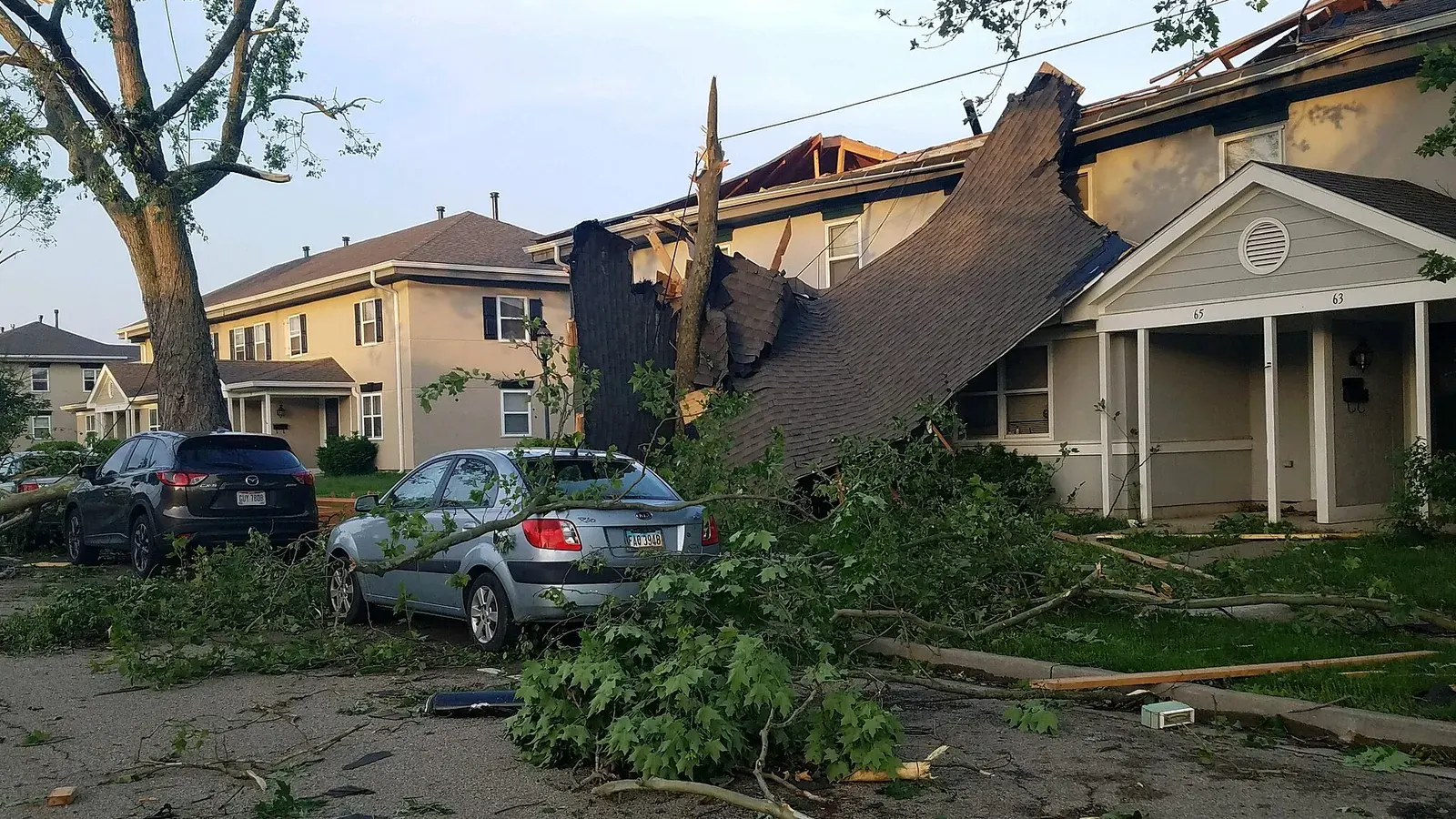
At 10:41 p.m. on May 27, an EF4 tornado ran east for 20 miles through Brookville, Trotwood, Dayton and Riverside, up to 0.6 mile wide, with winds near 170 mph. The National Weather Service found apartment buildings with their roofs and outer walls gone, and said it hit hundreds of homes, businesses and apartment complexes. The same night another tornado crossed eastern Montgomery and western Greene counties.
May 25, 2011
A storm cell dropped hail up to three inches across over the southern Dayton area, and a line of storms followed with winds of 40 to 60 mph, according to the National Weather Service. The NWS also confirmed a weak (EF0) tornado near Centerville in those storms.
Winter
January in Dayton averages a low of 23°F and a high of 37°F (Weather Spark). So there are days when snow melts and then freezes again at night. When heat from the house leaks into the attic, the melt runs down to the cold edge of the roof, refreezes, and builds an ice dam that can push water under the shingles. The U.S. Department of Energy's Building America guide says the most important fix is sealing the air leaks from the house into the attic, then insulating and ventilating.

Filing the insurance claim
Everything in this section comes from the Ohio Department of Insurance page on roof insurance, repair and replacement.
- You file the claim. Contact your insurer yourself. You can ask them, the Better Business Bureau or a trade group for a list of reputable contractors.
- Know your deductible. Most home policies have a separate wind and hail deductible, either a flat dollar amount or a percentage. A percentage is taken from what the home is insured for, not from the damage. A 2% deductible on a $300,000 home is $6,000.
- Replacement cost or actual cash value? Replacement cost pays to fix it with like materials. Actual cash value pays the cost minus depreciation. Ask which you have, and whether the age of your roof changes it. Many replacement-cost policies want the work done within a set window, such as 180 days.
- Do not give a contractor power of attorney, and don't let one negotiate or settle your claim.
- Don't let a contractor inspect when you're not home. If you allow an inspection, watch it.
- Pay by check or credit card, not cash, and don't pay in full or sign a completion certificate until all the work is finished.
- If you think a contractor has defrauded you, or told you to inflate a claim, the department's fraud hotline is 800-686-1527.
Storm chasers and door-knockers
Call a local roofer: (937) 907-1066After the 2019 tornadoes, the Ohio Attorney General sued a West Chester contractor accused of taking money to repair roof damage and then doing shoddy work or none. Several homeowners reported paying him more than $213,000 (WCPO). Not every contractor who comes to town after a storm is a crook. The Attorney General's advice is simple:
- Be cautious of anyone who knocks on your door and wants to start work right away.
- A business that solicits you at home must give you a three-day right to cancel and should not begin work for at least three days (the state counts three business days; Ohio Home Solicitation Sales Act).
- Don't make a large down payment. The state suggests paying in steps, for example a third at the start, a third when half the work is done to your satisfaction, and a third at the end.
- Be suspicious of "leftover materials from a job down the street" or unbelievably low prices.
- Walk away from a contractor who won't give ID, has no permanent place of business, can't give references, or insists on a large payment before work begins.
- Pay by credit card if you can. It protects you better than cash or a check.
- To report one, call the Attorney General's help center at 800-282-0515.
No state license: how to size up a roofer
Ohio does not license roofers statewide. The state's construction licensing board licenses contractors in electrical, HVAC, hydronics, plumbing and refrigeration, not roofing, and Montgomery County says state licensing is not required for general contractors or for one-, two- and three-family residential work. The City of Dayton's own contractor registration and bond forms list electrical, pipe-laying, plumbing and warm air heating, not roofing. So a roofer saying "I'm licensed" tells you little. Check these instead:
- Name, address, phone, and a real place of business.
- Complaint history with the Ohio Attorney General and the Better Business Bureau.
- Liability insurance. Ask for a certificate, and ask the insurer to send it to you.
- Workers' comp. Look the business up with the Ohio Bureau of Workers' Compensation. If a worker falls off your roof and the roofer has no coverage, that can become your problem.
- References you can call, and photos of recent work.
- A written estimate and contract that says what is included, the price, the deposit, and the start date.
Permits in Dayton
See what jobs cost on the price page.
- The full rundown is on our roof permit page. According to the City of Dayton, you do not need a building permit to put on a new layer of shingles. You do need one to replace or repair the wood sheathing under the shingles, or rafters or trusses.
- If your roof already has two or more layers, the new covering can't go on until all the old coverings are removed.
- Questions go to Building Inspection at 937-333-3883. Other cities and townships (Kettering, Beavercreek, Centerville and the rest) run their own offices, so ask yours. Outside city limits in Montgomery County, start with the county building regulations office.
- In a historic district such as South Park or the Oregon District, ask the city Planning and Community Development office (937-333-4271) whether you need a certificate of appropriateness.
Roof trouble in the Dayton area?
One call. You talk price with the roofer before anything starts.